Results and impact report

The world's first longevity Impact Lab

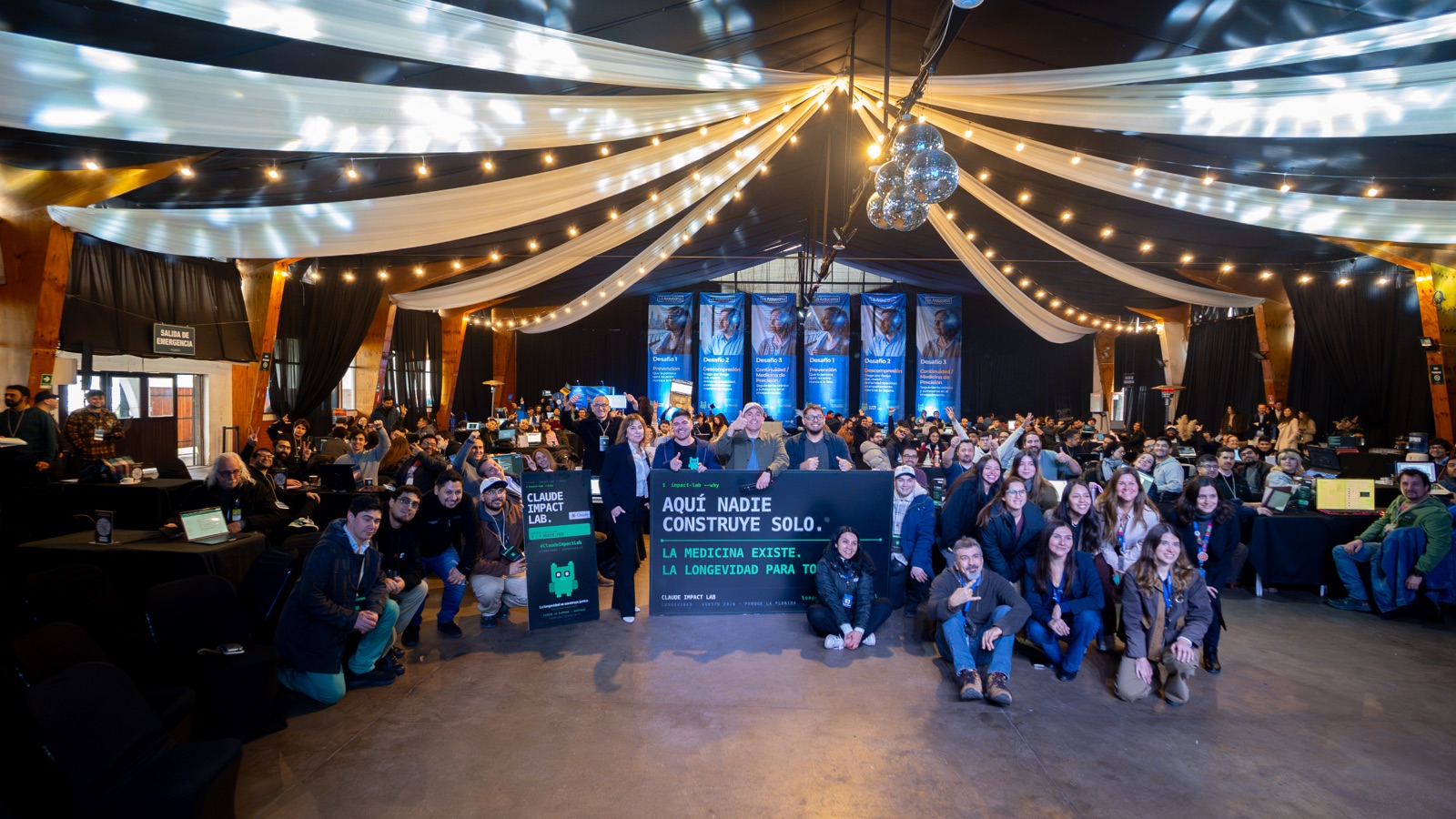
Two days in which 154 people built agents with Claude to tackle waiting times in Chile's public health system — and what that wait does to older adults.

August 5-6, 2026Parque La Florida · Santiago, Chile

Bendita IA · Felipe Pacheco, Claude Community Ambassador Chile

About the figures

Every number marked as verified comes from a query against the platform database, run on August 17, 2026. Figures from press coverage or on-site headcount are marked as such and are never blended with the former.

01 — Objectives and results

What we set out to do, and what happened

O1

Tackle real civic pain points, not laboratory cases

The three challenge tracks were defined around operational pain points of the Chilean public health system, worked out with the Ministry of Health. No team received a case study: each defined its own problem and defended it in front of professionals who live it daily.

  • 15Clinical professionals from the Ministry of Health, health innovation centers and La Florida community health centers, on site for both days
  • 43Completed initiatives, all addressing real problems of the Chilean public system
  • 6Recurring pain points identified when grouping the 43 submissions
  • −75%Measurable case: preparing a tele-referral to Hospital Digital drops from 30–48 minutes of physician time to roughly 10
O2

Turn AI users into AI builders

The gap the Impact Lab exists to close is not access to AI — it is role. Many people use AI at chat level; very few have built a solution with it. That jump, from user to builder, is the objective.

  • 37.7%Of those who built did not come from a developer profile: 34 health professionals and 12 from commercial/product
  • 34Clinical professionals building inside the teams, not advising from outside
  • 37Mixed teams, with two or more distinct profiles, out of 52 total
  • 30Teams with at least one health professional embedded
  • 43Teams that finished with a working agent, most with clinical members building for the first time
O3

Convene broadly and filter well

A broad call only works if the filter raises the floor. The signal that it worked is not how many applied, but how tightly quality clustered at the top.

  • 757Applications received
  • 21.5%Acceptance rate
  • 10Of the 12 finalists scored above 90 out of 100
  • 0.6 ptsGap between first and second place in the Prevention track

Ten of twelve finalists scored above 90: quality clustered so tightly at the top that two cross-track awards were added to the three track winners — Best AI Builder and Best Vibecoder.

02 — The numbers

Call and participation

Call for applications

757
applications received
756 Chile · 1 Peru
163
accepted
417
waitlisted

Actual participation

52
teams reached the event
of 91 created
154
people building
43
initiatives with complete submission

Evaluation

1,443
evaluations recorded
29
evaluators
13 mentors · 16 judges
12
finalists · 3 winners

Who built

AI Builders
59 · 38.3%
Vibecoders
37 · 24%
Health professionals
34 · 22.1%
Commercial / Product
12 · 7.8%
No category declared
12 · 7.8%

Total attendance including the evaluation panel, public officials and staff: close to 200 people. (press / on-site count)

03 — The problem

The six pain points they chose to solve

No team was assigned a case. Grouping the 43 submissions they delivered, six recurring pain points emerge — all verifiable in the actual operation of the Chilean system.

People aged 60 and over are today 18.1% of Chile's population and will be 32.1% by 2050. The public system responds with waiting lists ordered primarily by entry date, not by clinical risk.

Deterioration that advances undetected

9 teams

The system funds the severe outcome but not the screening that prevents it. Teams worked on dysphagia — which progresses silently to pulmonary aspiration and is detectable in five minutes — loss of purpose in older adults with chronic conditions, loneliness recorded nowhere, and latent cardiovascular risk in younger adults.

A queue ordered by date, not by risk

14 teams

More than 2 million Chileans wait for a specialist consultation and the queue advances by seniority. Teams built systems that re-read the referral and reorder by clinical severity, detect released slots and reassign them, or simulate the surgical schedule to anticipate bottlenecks.

Administrative work consuming clinical time

5 teams

Preparing a tele-referral to Hospital Digital currently takes 30 to 48 minutes of physician time. That is where the time goes: manually coding free text.

Discharge that interrupts care

17 teams

Post-stroke rehabilitation nobody supervises, discharge summaries patients do not understand, medical information that by law belongs to them but is scattered across institutions, and chronic care appointments with high no-show rates.

Medication-related harm

3 teams

Quantified with an official source by one of the teams: up to 11,726 hospitalizations and more than 50,000 bed-days per year in Chile.

The AI adoption gap in healthcare

4 teams

Several teams named the underlying problem: there is a chasm between AI use in software or business and its use in healthcare, and the reason is clinical risk. That diagnosis motivated this edition's own evaluation criterion.

04 — What made this edition different

The most valuable contribution was not technical

Chile's Ministry of Health, health innovation centers and the community health centers of La Florida contributed 15 health professionals — nutritionists, nursing technicians, nurses, physicians, pediatricians and longevity specialists — present on site for both days.

Their role was not to evaluate. It was to tell the teams, first-hand, how to build with AI for the Chilean reality — and specifically for the reality of low-income districts: where the patient does not have unlimited mobile data, the primary care center has no integration with the hospital, and the older adult does not necessarily know how to use an app.

This changed the outcome in observable ways. The projects that reached the finish line do not propose imported solutions: they propose workflows that fit inside a primary care center, WhatsApp channels because that is what people already use, and on-device processing when connectivity cannot be assumed.

It is also what made it possible to evaluate "built something with Claude" by observing it live, with the mentor present, instead of requiring teams to package it into a repository, a video and screenshots.

05 — Claude at the event

Two layers of use

In the projects

All 43 teams built agents with Claude. The most recurrent patterns:

Conversational agents over WhatsApp

Text and voice, because it is the channel the target population already uses.

Clinical concept extraction from free text

With mandatory human validation and explicit flagging of what the agent could not resolve, instead of inventing it.

Validated clinical instruments, unmodified

EAT-10, PHQ-2, GDS-5, GAI-SF — with scoring computed by deterministic code, not by the model.

Deterministic tool use for escalation

With concrete numeric thresholds, rather than leaving the decision to the model's memory.

Running the event

The platform includes Bendi, an in-house agent built on Claude Haiku 4.5 that assisted the evaluation panel. It pre-evaluated each submission and left a dossier — summary, strengths, areas for improvement, flags and suggested Q&A questions — which the mentor confirmed or corrected.

46
executive summaries generated
184
sub-check pre-evaluations
107 pass · 52 fail · 25 uncertain
198,617
tokens processed in summaries
145,815 in · 52,802 out

The human always decided. Every divergence between the model's suggestion and the evaluator's decision was recorded for later audit. The total cost of running the evaluation with Claude was in the tens of dollars, not thousands.

06 — Methodology

A rubric redesigned for healthcare

This edition's rubric was not the fintech Impact Lab rubric translated. It was redesigned from the actual averages of the previous edition, which revealed which criteria measured the solution and which measured the ability to fill in forms.

We removed criteria that required fabricating artifacts that exist only to be evaluated — a demo video, JSON schemas pasted by hand — and that structurally penalized vibecoders, who are an awarded category.

The healthcare-specific criterion

Does the team state what its agent does NOT do, and when it escalates to a human?

An agent that suggests a diabetic patient skip a consultation is a risk that does not exist when the domain is financial regulation. It is verified by reading three short declared fields, not the full system prompt: to know whether it escalates on chest pain, a team does not need to expose what it considers its product.

In the judging phase the equivalent criterion was: the team can defend the clinical decision — it knows why its agent escalates when it escalates. The result is that the winning projects state their limits explicitly: they do not diagnose, do not prescribe, do not adjust dosage, and escalate at defined thresholds.

07 — Results

Three winners, one per track

Judged live by a panel of 16 healthcare judges against a public rubric. All three receive specialized support to move toward a pilot.

🏆 Track 01 · Prevention4 members

«The best waiting list is the one that never starts.»

Team FilaZero

94.5pts

An agent that detects loss of purpose in adults over 60 with chronic conditions: when someone stops having a reason to get up, they stop moving, and that inactivity accelerates loss of autonomy. It applies validated clinical instruments without modifying them, explains the result in plain language and proposes a weekly action. It explicitly states that it does not diagnose or prescribe, and defines escalation on suicidal ideation.

🏆 Track 02 · Decompression4 members

«Let's get people out of the queue.»

Minsal

100.0pts

Preparing a tele-referral to Hospital Digital currently takes 30 to 48 minutes of physician time. Their agent extracts clinical concepts from free text and proposes the coding by querying the official terminology service, cutting the process to about ten minutes. The physician validates every term and the agent never writes on its own: if it finds no match, it flags it for manual review instead of inventing one.

🏆 Track 03 · Continuity2 members

«Live more years. Live those years better.»

KINEVIEW

96.2pts

After discharge from a stroke, recovery depends on daily home exercises nobody supervises, and the physiotherapist only sees the person again weeks later. Their application lets patients exercise in front of the phone camera — movement is processed on the device itself — and sorts the physiotherapist's queue by risk priority. Clinical decisions remain with the professional.

See all 43 initiatives

08 — Record

The two days

Event photographs are hosted on Google Drive with controlled access. They are not republished openly: the platform did not record image consent from participants.

07b — In their words

The winners, in their own words

The three teams explain what they built and what comes next.

9:41
EN
Interview with the winners
Team FilaZero · Minsal · KINEVIEW

08c — Decentralization

They drove hundreds of kilometers to get here

Four teams travelled from the regions to build. Not from a neighboring district: from Talca, Chillán, Cabrero and Puerto Montt. The Puerto Montt team drove more than a thousand kilometers.

It matters because the problem they came to solve is their own. Waiting lists do not feel the same in Santiago as they do in Ñuble or Los Lagos, where the nearest specialist can be hours away. The teams that best understand the cost of waiting do not live in the capital.

Claude reaching them — and not only the Metropolitan Region — is the difference between a capital-city tool and a country-wide one.

9:41
EN
Teams from the regions
Why they travelled to Santiago
SantiagoEvent venueTalcaMaule · 255 kmChillánÑuble · 400 kmCabreroBiobío · 470 kmPuerto MonttLos Lagos · 1,020 km
Positioned by actual latitude. Road distances to Santiago, approximate.

08b — Reels

The event on video

Each day’s recap plus the teams in their own voice. Tap to play with sound.

9:41
EN
Day 1 Recap · Claude Impact Lab Longevity
August 5, 2026 · Parque La Florida
9:41
EN
Day 2 Recap · Claude Impact Lab Longevity
August 6, 2026 · Parque La Florida
9:41
EN
The teams, in their own voice
What they built and why

09 — Lessons

What we learned

We report this because it is what makes the format replicable: every point here is already built into the design of the next edition.

  1. 01

    Shortlisting is the critical point

    Going from 52 teams to 12 finalists was the hardest thing to operate. For the next edition, mentors are coordinated weeks in advance and receive their assigned teams before the event.

  2. 02

    The registration form asked the wrong question

    Registration measured "AI experience", which lumps someone who used a chat to draft an email together with someone who built an agent. These are different populations, and that difference is precisely what the Impact Lab exists to close. The next edition separates AI use from AI development.

  3. 03

    Recognition was broadened along the way

    Ten of the twelve finalists scored above 90: quality clustered too tightly at the top for three awards. Two cross-track mentions were added —Best AI Builder and Best Vibecoder— recognising axes the podium does not measure: agent architecture and the use of assisted-build tooling. The next edition starts with that structure by design.

  4. 04

    Requiring a pitch from every team creates uneven load

    We are evaluating recording presentations in a bounded window to support shortlisting, instead of requiring a universal pitch that penalizes small teams.

  5. 05

    The agentic bonus decided a track, and decided it right

    The «agentic thinking» criterion —custom MCP, multi-agent, Extended Thinking, Agent SDK— adds 5 points and is applied by the evaluator who saw the work. Six of the twelve finalists earned it. In Prevention it separated first from second place, which is exactly what it should do: an Impact Lab rewards building WITH Claude, not using it, and that distinction is the premise of the event turned into score. What is worth improving is not the criterion but where its definition lives: it sits in the evaluator form rather than in the rubrica_json that is versioned and published with the rest. Anyone reading the rubric later to reconstruct how teams were judged will not find it there.

  6. 06

    On-site criteria work, but the conditions must be planned

    Evaluating "the agent working" with the mentor present was the right call. What was missing was ensuring each mentor had the time and the place to observe it.

10 — Reach

Institutional backing and coverage

Driven by Caja La Araucana, together with Anthropic, SURA, Mediclic, Sirak and Mundo. Operated by Bendita IA.

Attended by Patricia Soto, acting Superintendent of Social Security, and Elisa Cabezón, Undersecretary of Social Welfare.

«Chile made history with the world's first longevity Claude Impact Lab»
La Tercera

11 — What comes next

Next steps

  • Specialized support for the three winners toward a pilot in the health ecosystem.
  • Anthropic API credits for the teams that submitted evidence.
  • Verifiable certification for participants and the evaluation panel, with a web credential and unique code.
  • Public compendium of the 43 initiatives, with each team's description in their own words.

Next edition

October 23-24, 2026 · San Joaquín, Santiago

AI is built together. And it is built here.

Bendita IA · Claude Community Ambassador Chile

Published as an open record of the event. Every figure can be audited against the platform.